A bay length is a pitch, and a pitch is a ceiling on throughput
The length of a conveyor segment is not a size. It is the distance between two parcels, and that distance sets the highest throughput the line can reach before any question of speed or induction is asked.
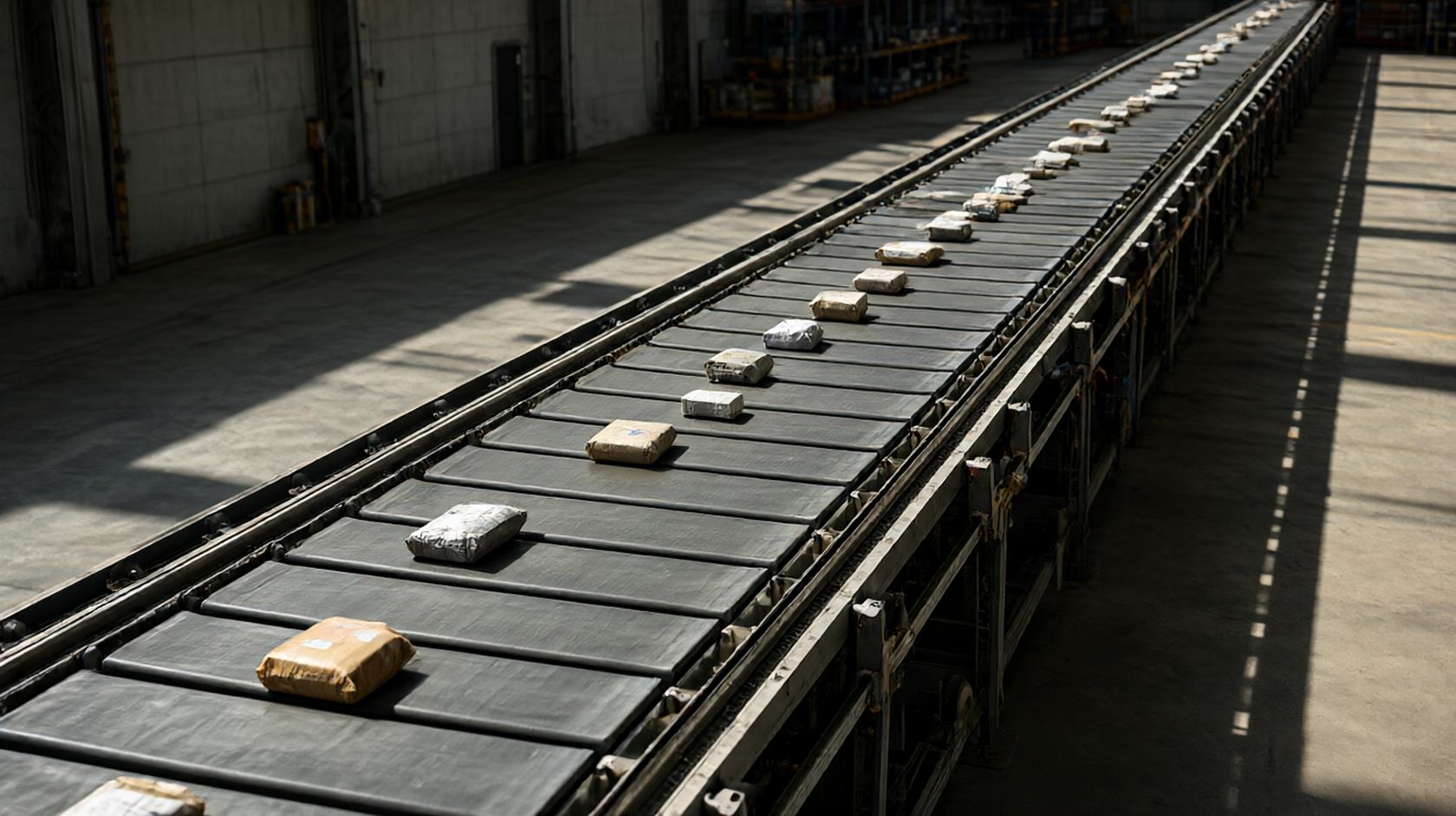
Pitch is the number that was never quoted
A segment has a length and the parcel on it has a length, and the difference between the two is the gap. Pitch is the segment length plus the gap, and it is the number that determines how many parcels can pass a point in an hour at a given speed.
Suppliers quote speed and rated throughput, and both are derived from pitch without naming it. When a buyer compares two lines on throughput, the comparison is really between two pitches, and the line with the shorter pitch has the higher ceiling whether or not that was the intent.
The pitch is also a constraint on the parcel. A parcel longer than the segment cannot sit within one pitch, so it occupies two, and the second segment cannot carry another parcel while it does. A line sized for cartons will lose a measurable share of capacity the moment long items enter the mix.
Which means pitch belongs in the specification as a number, beside the width and the speed. A specification that states only throughput has hidden the number that determines whether the throughput is achievable for the actual parcel mix.
The theoretical ceiling is simple arithmetic
Throughput in parcels per hour is the belt speed divided by the pitch, converted to consistent units. A line running at a given speed with a given segment length has a hard ceiling that no amount of induction skill can exceed, because two parcels cannot occupy the same space.
This ceiling is the right first check on any quoted throughput. If the quoted number exceeds speed divided by pitch, the quote is describing a different configuration or a different parcel mix, and the discrepancy should be resolved before the price is discussed.
The ceiling also tells the buyer where the headroom is. A line quoted at eighty percent of its ceiling has room for a faster induction or a denser mix. A line quoted at ninety eight percent of its ceiling has no room at all, and the first seasonal peak will expose that.
The arithmetic is worth doing in both directions. Working back from a required throughput gives the maximum pitch the line can have, and that maximum pitch is what constrains the longest parcel the line can carry efficiently. The two constraints are the same constraint.
Why the achieved number is lower than the ceiling
The gap between the ceiling and the achieved throughput is made of four things: induction rhythm, gaps that the induction logic leaves empty, parcels that fail a scan and have to be re circulated, and stoppages. Each is separately measurable and each is separately improvable.
Induction rhythm is the largest of the four in most installations. The induct operator or the auto induct has a cycle time, and if that cycle time is longer than the pitch time, the belt runs with gaps that the ceiling does not account for.
Empty gaps are created deliberately by control logic, because a gap is cheaper than a collision. Logic that holds a small safety margin on every induction will hold a large cumulative gap over an hour, and the margin is usually set once and never revisited.
Recirculation is the invisible one. A parcel that fails a scan and goes around again consumes capacity twice, and the failure rate is usually measured on the first pass only. Measuring it on total passes gives a number that is roughly double, which is closer to the capacity cost.
Short segments raise density and cap the parcel
A short segment allows more parcels per metre of line, which raises the ceiling at the same speed. It also caps the longest parcel at the segment length, and the cap is hard: a parcel longer than the segment is not slightly degraded, it is structurally unable to travel within one pitch.
This is a good trade for a catalogue of small parcels and a bad trade for a catalogue with a tail of long items. The tail does not have to be large to hurt, because a small number of long parcels occupies two segments each and the capacity loss is proportional to their share of the volume.
The usual resolution is a bypass rather than a compromise. Long items are diverted before the sorter and handled on a separate line, and the sorter is specified for the dense mix it handles best. The bypass costs floor space and it preserves the sorter's ceiling.
The other resolution is a mixed pitch, where alternating segments are longer. This is mechanically possible and administratively awkward, because the control logic has to know which segment a parcel is on and the induction has to place accordingly. It is worth it only when the long item share is stable and large.
Long segments carry the long item and waste the short one
A long segment carries the long item comfortably and wastes space on every short one. On a line with a mix dominated by short parcels, a long pitch means the belt is mostly empty, and the emptiness is paid for at the full cost of belt, frame, motor and footprint.
The waste is quantifiable. If the average parcel occupies a fraction of the pitch, the line is carrying air for the remainder, and that fraction is the ratio between the achieved throughput and the ceiling. A line at sixty percent of its ceiling is a line whose pitch is too long for its mix.
Long segments are also slower to divert. The divert window is the time a parcel spends over the divert point, which is segment length divided by speed, so a longer segment gives a longer window at the same speed. That is the genuine engineering benefit, and it matters for fragile or heavy items.
Which means the case for a long segment is usually about divert reliability rather than about parcel length. A line that jams at the divert because the window is too short will be fixed by a longer segment or a slower speed, and slowing down costs throughput in exactly the way a longer segment does.
The mixed line problem is a pricing problem
A single line serving a mixed catalogue has to be specified for the worst case in each dimension: the widest parcel, the longest parcel, the heaviest parcel. Every one of those specifications is paid for on every parcel, including the parcels that need none of them.
The consequence is that a mixed line is economically worse than two dedicated lines whenever the mix is genuinely bimodal. The crossover is the point where the savings from not over specifying one line exceed the cost of a second line's footprint, frame and controls.
Bimodality is testable from the shipment data. Plot parcel length against frequency and look at the shape. A single hump means one line is right. Two humps mean the specification is a compromise, and the size of the second hump tells you how much the compromise costs.
The decision should be made with that plot on the table rather than with a rule of thumb about parcel sizes. The plot is usually more informative than any general guidance, because it describes the catalogue that actually exists rather than the catalogue in the plan.
Changing the pitch means changing the frame
Pitch looks like a parameter and is actually a structural property. Changing it means changing segment count, frame length, divert positions, drive arrangement and the control logic that maps parcels to segments. It is not a setting, and it cannot be deferred.
This is why the pitch decision has to be made with the parcel mix rather than with the budget. A line bought with a long pitch to save money on segment count will cost more later, because the retrofit is a rebuild and the rebuild happens while the operation is running.
The one adjustable element is the gap, which the control logic can tighten or loosen. Tightening the gap raises the achieved throughput toward the ceiling and reduces the safety margin for induction errors. Loosening does the reverse. That is the only knob available after installation.
So the specification work should fix the segment length against the parcel length distribution and treat the gap as the tuning variable. A buyer who fixes the gap and hopes to change the segment length later has the two variables backwards.
The divert window shrinks as speed rises
A divert has to move a parcel off the belt within the time the parcel spends over the divert mechanism. That time is the segment length divided by the belt speed, so every increase in speed shortens the window in proportion.
The window determines what the divert can reliably do. A pusher needs enough time to extend and complete its stroke. A shoe needs enough time to travel across the belt. A pop up mechanism needs enough time to rise, transfer and retract. Each has a minimum, and the minimum rises with parcel weight.
This is the coupling that catches buyers who specify speed for throughput and then discover the divert cannot keep up. The line runs at the higher speed and the divert failure rate rises, and the achieved throughput falls below what the slower speed would have delivered.
The resolution is either a longer segment, which restores the window and costs density, or a different divert technology with a shorter minimum window. Choosing between those two is a decision about the parcel mix, because the technologies differ in what they handle well.
More segments means more maintenance points
Every segment has a belt or a tray, a bearing, a drive element and a tracking adjustment. Segment count is therefore a maintenance workload multiplier, and a line with twice the segments has roughly twice the inspection points for the same throughput.
The maintenance implication should be part of the pitch decision, not an afterthought. A short pitch line that raises throughput by twenty percent and doubles the number of tracking adjustments may consume the gain in labour, and the labour is a recurring cost against a one time capacity gain.
Access is the constraint that makes this concrete. A segment that cannot be reached without removing a guard takes longer to inspect than one with a clear approach, and pitch affects access because shorter segments put more hardware into the same length of frame.
The practical specification includes an access requirement: every segment reachable from one side without dismantling, and the guards designed for removal rather than for permanence. That requirement costs little at the design stage and a great deal afterwards.
Three numbers to run before the quote
The first is the peak hour parcel count, taken from the busiest week rather than the average week. Peak is what the line is bought for, and the average is what the line will spend most of its life doing.
The second is the length distribution of parcels at the ninety fifth percentile, which sets the segment length. The ninety fifth rather than the maximum, for the same reason as width: the maximum is a manual case, the ninety fifth is a daily case.
The third is the acceptable minimum gap, which comes from the induction accuracy the operation can actually achieve. An operation that has never measured its induction error rate will pick a gap that is either too tight to run or too loose to be efficient.
With those three numbers the required pitch and the resulting ceiling are both computable before any supplier is approached. That changes the conversation from comparing quoted throughputs to checking quoted throughputs against a number the buyer already knows.
The line this arithmetic describes is the narrow belt sorter built on a short bay, and its bay length is what fixes the pitch before any question of speed is asked.
- Write the pitch into the specification as a number beside speed and throughput.
- Check every quoted throughput against speed divided by pitch.
- Measure induction cycle time before accepting a throughput figure.
- Account for recirculation on total passes rather than first passes.
- Take the ninety fifth percentile of parcel length for the segment length.
- Route oversize items to a bypass rather than compromising the pitch.
- Compute the share of pitch that the average parcel actually occupies.
- Plot parcel length against frequency to test for bimodality.
- Treat the gap as the only post installation tuning variable.
- Check the divert window at the specified speed before choosing the technology.
- Count maintenance points per segment in the pitch decision.
- Require every segment to be reachable from one side without dismantling.