Twelve hundred millimetres is where the parcel stops behaving like a box
A wide wheel bed is specified for parcels that a tray cannot hold: soft, irregular, long, or simply too large for a belt. The width is the visible number, and the wheel geometry underneath it is what actually decides what the line can carry.
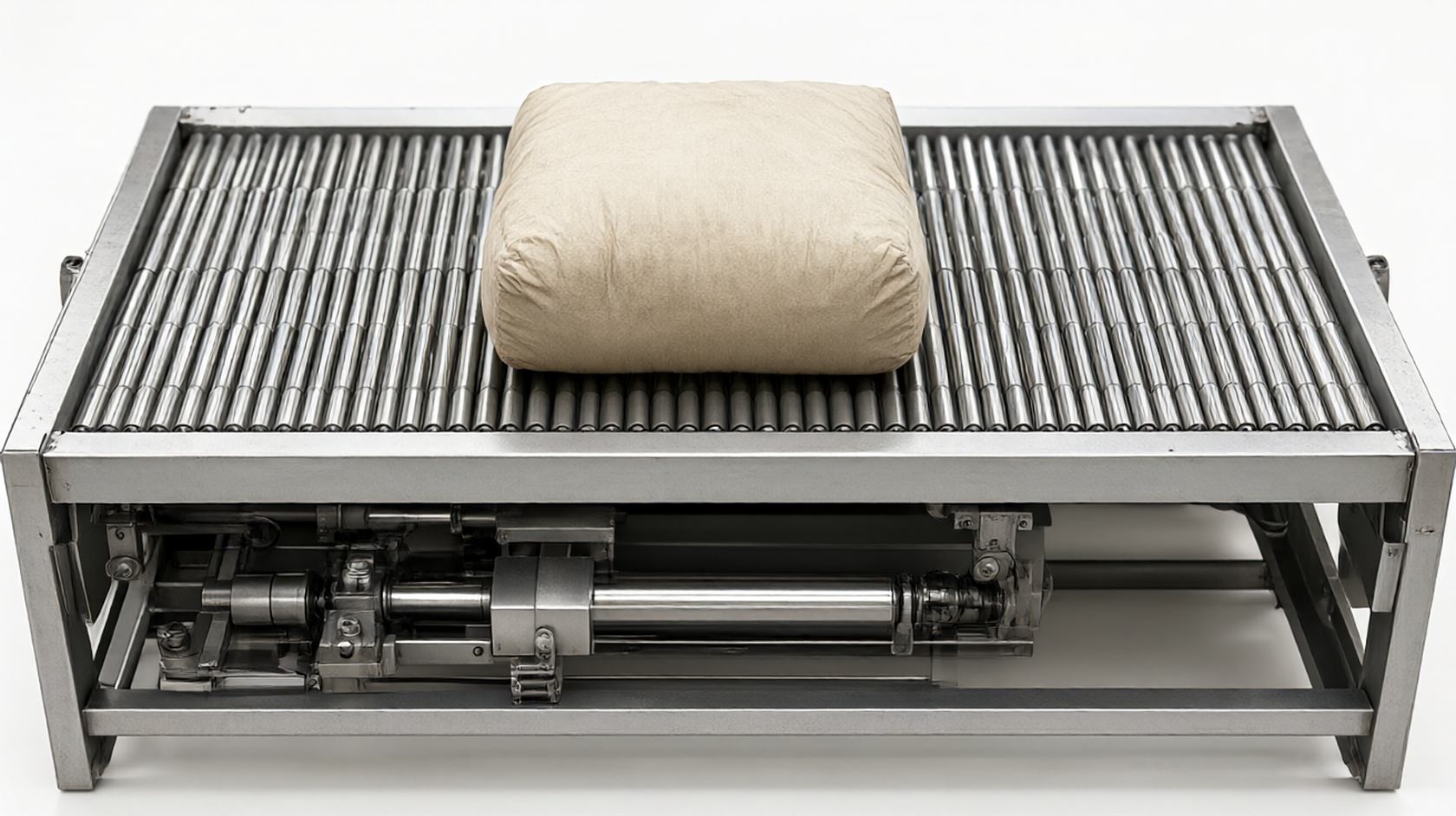
A wheel bed supports rather than grips
A belt carries a parcel by friction across a continuous surface. A wheel bed carries a parcel by contact at a set of points, and the parcel has to be stiff enough to bridge those points without sagging between them.
That difference is why wheel beds are used for large and irregular items. A soft large parcel on a belt needs a tray or a wide belt to hold its shape, while the same parcel on a wheel bed is supported at many points and conforms to the bed rather than to a tray.
The support is also the limitation. A parcel that is flexible enough to drape between the wheels will drape, and a draping parcel can touch the frame or the drive train below the bed. The wheel spacing therefore determines the softness the line can accept.
A twelve hundred millimetre width extends this logic sideways. The wider the bed, the more wheels across it, and the more contact points a large parcel has. The width is not for bigger boxes so much as for bigger soft things.
Wheel diameter sets the smallest parcel
The gap between adjacent wheels is the smallest dimension a small item can fall through, and the gap depends on the wheel diameter and the spacing. A larger diameter allows a wider spacing at the same load capacity, which widens the gap and lets smaller items through.
This is the opposite trade from the one buyers expect. A heavy duty bed with large wheels is a bed that cannot carry small parcels, because the gaps are larger and the contact points fewer. A line carrying both needs a small item kit rather than a compromise wheel.
The gap also changes along the bed. At the transitions between sections, the gap is a compound of two wheel patterns, which is wider than either. A small parcel that travels the whole bed will find the transition even if it could bridge the pattern.
The practical specification is the minimum parcel footprint by weight, stated together. A light small parcel needs a narrow gap and a light wheel load; a heavy small parcel needs a narrow gap and a robust wheel, and the two requirements point at different designs.
Width changes the steering, not only the support
On a narrow bed, a parcel that drifts sideways reaches the guard quickly and is pushed back. On a wide bed, the parcel can drift a long way before anything corrects it, and the correction, when it comes, is larger.
The correction is a problem because a large correction at a divert is a large lateral acceleration. A wide bed therefore needs either a longer divert zone or a gentler divert angle, and both cost length along the line.
The width also changes the divert geometry. A divert that pushes across twelve hundred millimetres has to move the parcel twice as far as one pushing across six hundred, so the divert zone is longer and the parcel spends more time in it. The throughput effect is real and it appears in the divert cycle time.
Where the divert is a pop up wheel unit that rotates to steer, the width matters differently. The unit has to cover the bed, so a wide bed means a wider unit and a heavier lift, which affects the cycle time and the wear on the lift mechanism.
Transfer points are where a wheel bed fails
A wheel bed transfers a parcel to a chute, a belt or another wheel bed, and each transfer is a place where the support pattern is interrupted. The interruption is the gap the parcel has to bridge, and a soft parcel will not always bridge it.
The transfer to a belt is the most common failure because the belt surface is higher than the wheel tops or lower, and the step at the junction catches the leading edge of a soft parcel. A parcel that catches on the step rotates, and a long parcel that rotates blocks the transfer.
The transfer to a chute is easier in one direction and harder in another. A chute that continues the direction of travel is a smooth handover; a chute at an angle is a change of direction that a large parcel resists because its length is still on the bed when its front is in the chute.
The design answer is to keep transfers aligned and to keep the step between surfaces small relative to the parcel thickness. A large parcel tolerates a step that a thin parcel would catch on, and a line carrying both needs the step set for the thin one.
Large parcels need a base that can take a point load
A wheel bed concentrates load at the contact points. A large parcel's own weight is distributed over its base, and the base has to be strong enough to carry the resulting pressure without crushing or deforming.
A corrugated carton with a heavy contents is usually fine, because the board distributes the load across the flutes. A soft bag with a heavy contents is not, because the bag conforms to the wheels and the contents press directly onto the contact points.
This is a packaging specification question that the warehouse cannot solve, and it is the reason some large soft goods have to be routed to a different line regardless of the sorter's rated capacity. A line that can physically carry the parcel may still damage it.
The specification should therefore state the minimum base rigidity for the parcel class, which is a joint requirement between the sorter and the packaging. A sorter specified without it will be blamed for damage that the packaging caused.
The wide bed and the dense bed are complementary
A wide wheel bed is slow and forgiving. A narrow belt sorter is fast and demanding. They serve different populations and the correct configuration is usually both, with a routing decision between them.
The routing decision is made on footprint and weight, and it should be made early, at the merge, so that each parcel reaches the right line with the least handling. A routing decision made late is a parcel that has already been through a transfer it did not need.
The two lines also complement in failure modes. A dense belt line jams on oversize parcels; a wheel bed rarely does. A wheel bed damages soft heavy parcels; a belt line rarely does. Running both means neither failure mode dominates the operation.
The exception in both directions is the parcel that fails on both lines, which is usually a heavy soft oversize item. That population has to be identified and handled manually, and the size of it is a fact about the catalogue rather than about the equipment.
Accumulation behaves differently on wheels
Parcels accumulate on a wheel bed by touching each other, and the contact is at the wheels rather than across a surface. The resulting back pressure is lower and the parcels are easier to release, which is an advantage for zero pressure accumulation.
The disadvantage is that a parcel sitting on wheels can settle between them over time, especially if it is soft and if the bed is not running. A long dwell in accumulation is therefore a deformation risk that does not exist on a belt.
The dwell time in accumulation is a design parameter rather than a side effect. A line with a long accumulation zone and slow release will hold soft parcels on wheels for minutes, and minutes are enough for a soft parcel to take the shape of the bed.
The control answer is to keep soft parcels moving through accumulation rather than dwelling, which means the accumulation logic has to know the parcel class. A logic that treats all parcels the same will hold the soft ones as long as the hard ones.
Twelve hundred is also a downstream requirement
A wide bed discharges into a chute or a station that has to accept the parcel's width. A twelve hundred millimetre parcel arriving into a six hundred millimetre chute is a parcel that lands on the chute lip and stops.
The downstream requirement therefore propagates all the way to the packing bench or the pallet build. A wide line is a line whose outputs are wide, and the outputs are where the floor space is usually already committed.
This is the reason wide lines are often specified with a narrow discharge and a rotation step, which is a transfer that turns the parcel to present its narrow face. The rotation step costs a mechanism and a jam point and it makes the downstream narrower.
The alternative is to keep the wide output and widen the downstream, which is a floor plan decision. The trade is between a mechanism at the sorter and floor space at the output, and the mechanism is usually cheaper to install and more expensive to maintain.
Noise, wear and the maintenance profile
A wheel bed has many small rotating parts, and each is a wear item. The maintenance profile is therefore broad rather than deep: many items inspected frequently, few items replaced rarely.
The inspection frequency follows the load. A wide bed carrying heavy parcels wears its wheels faster at the points where the load concentrates, which is usually the centre of the bed and the divert zones. A uniform inspection schedule misses the concentration.
The noise profile is different from a belt line. Wheels running under load produce a continuous rumble rather than the cyclic noise of a belt joint, and the rumble is harder to attenuate because it comes from the whole bed rather than from a few points.
The practical maintenance answer is condition based rather than schedule based. A wheel that has lost its profile is visible and audible before it fails, and a monthly walk that listens and looks is cheaper than a scheduled replacement of the whole bed.
The specification page for a wide line
It states the parcel classes the line must carry, the minimum footprint by weight, the maximum weight per wheel, the minimum base rigidity and the maximum dwell time in accumulation.
It also states the downstream width, the rotation requirement if any, and the transfer step tolerance at each junction. Those three items are where wide lines fail in operation, and they are the three that are most often left to the installer.
From those numbers the wheel diameter, the spacing, the bed width and the divert type follow. Each is a derived quantity and each has a reason recorded beside it.
A wide line specified this way is a line that carries what it was bought for and refuses what it was not, and the refusal is a designed behaviour rather than a jam.
The wide bed this note specifies is the pop up wheel sorter across a twelve hundred millimetre bed, and the wheel geometry under it is what decides the smallest parcel the line will ever carry.
- Specify the wheel bed for soft and irregular parcels, not for large boxes.
- State the minimum parcel footprint by weight rather than by size alone.
- Check the compound gap at section transitions, not only the pattern gap.
- Allow a longer divert zone for a wide bed and check the divert cycle time.
- Keep transfer steps small relative to the thinnest parcel carried.
- State the minimum base rigidity required of the packaging.
- Route between a wide wheel line and a dense belt line at the merge point.
- Keep soft parcels moving through accumulation instead of dwelling on wheels.
- Confirm the downstream width before specifying the bed width.
- Decide between a rotation step and a wider downstream explicitly.
- Inspect wheel wear where load concentrates rather than uniformly.
- Replace the uniform wheel schedule with a condition based walk.