A long cell carries the large item and rearranges the line around itself
Sizing a cell for the longest parcel in the catalogue is a decision that propagates: fewer cells, wider curves, different discharge timing, and a mixed line that has to be planned around the exceptions rather than the volume.
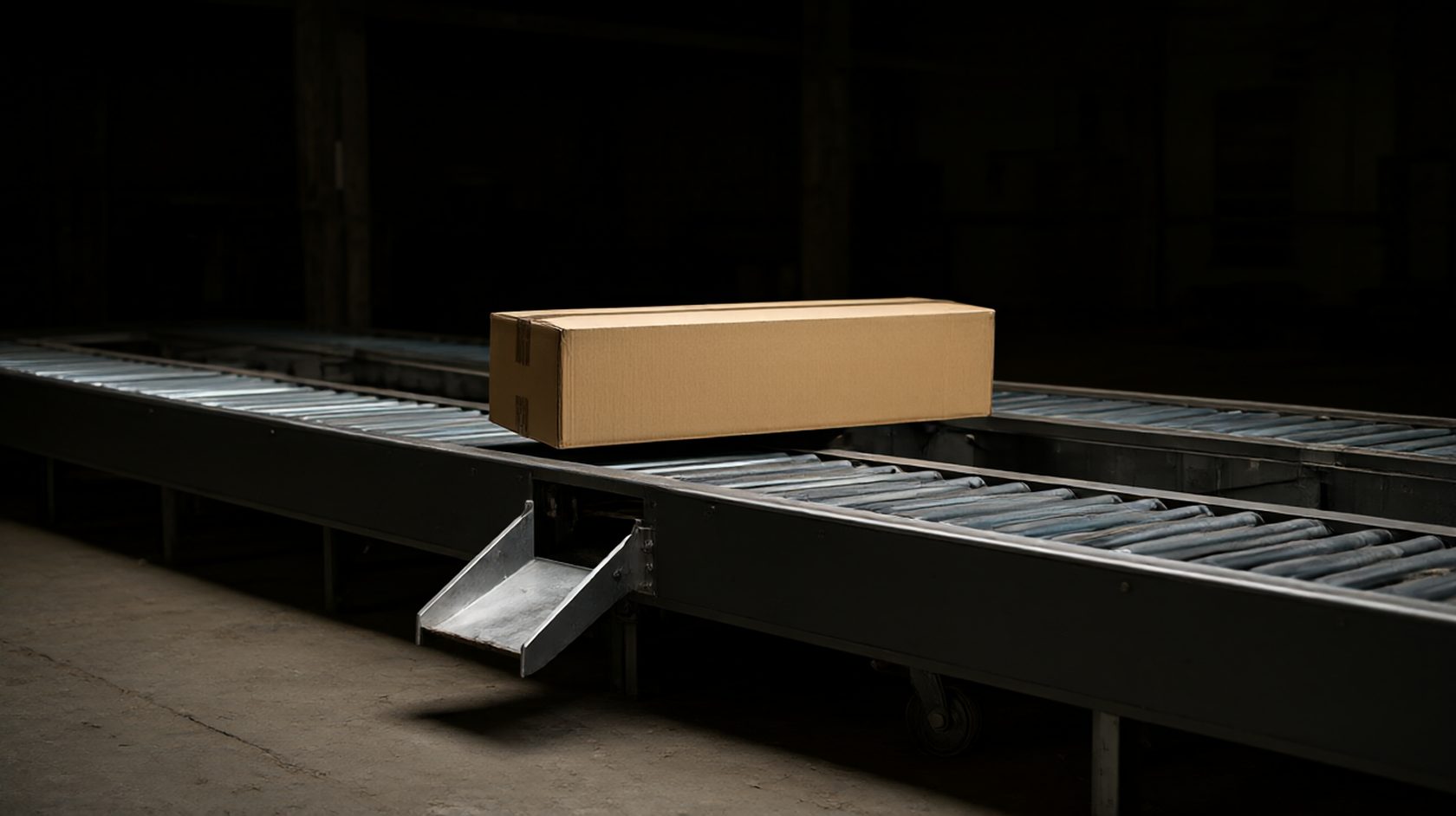
A long cell exists to solve one parcel
A cell is sized for length when the catalogue contains parcels that cannot sit within a shorter one. Those parcels are usually a minority, and they are usually the ones with the highest unit value, which is why operations are reluctant to route them to a manual lane.
The parcel that drives the decision is not the average large parcel, it is the largest one that has to be handled automatically. If the operation is willing to handle the top of the distribution manually, the cell can be sized to the ninety fifth percentile instead of the maximum.
The distinction matters because the cell size applies to every parcel. A cell sized for the maximum is a cell whose capacity is mostly empty on the majority of parcels, and that emptiness is a permanent capacity loss rather than an occasional one.
The right question is therefore which parcels must be automatic, not which parcels exist. A furniture retailer and a fashion retailer both ship large items, and only one of them needs those items on the sorter, because only one of them has the volume to justify it.
A long parcel occupies more than one cell
A parcel longer than a cell cannot sit within one, so it spans two. The second cell cannot carry another parcel while it is occupied, which means the long parcel consumes two cells of capacity and one cell of pitch.
The control system has to know this, because the induction cannot place a parcel on the cell behind the long one, and the discharge cannot happen until both cells are adjacent to the chute. A control system that assumes one parcel per cell will place a parcel into the occupied cell and the collision is mechanical rather than logical.
The capacity effect is proportional to the share of long parcels multiplied by the extra cells they consume. A five percent share of two cell parcels costs five percent of capacity, which is a modest number, and it is the number that should be compared against a dedicated line.
The mechanical effect is the one that is harder to manage. Two cells carrying one parcel have to move in synchronisation during the discharge, and any tracking difference between them becomes a twist in the parcel, which is how a long carton leaves the tray at an angle.
Two cell discharge is a synchronisation problem
Discharging a long parcel requires both cross belts to run at the same speed and to start at the same instant. A small timing difference produces a rotation, and a rotation on a long parcel is a large displacement at the ends.
The control system therefore needs a paired discharge mode, and the mode needs a check that both cells are present and ready. A paired discharge issued to one cell and one empty neighbour produces a partial discharge that leaves the parcel half on the tray.
The mechanical tolerance is what makes this achievable. Cells on a common frame with a common drive train are easier to synchronise than cells with individual drives, and the difference shows up as the maximum parcel length that can be discharged reliably rather than as a specification number.
Where the cells have individual drives, the synchronisation has to be closed loop and verified, and the verification is a commissioning test rather than a design assumption. A paired discharge that works in a dry test may fail under load because the two drives respond differently to the parcel's mass.
The centre of gravity moves with the parcel length
A long parcel placed centrally has its centre of gravity near the middle, which is where the two cells meet. That is a stable position and it is the position the induction should produce, because a long parcel offset along the line puts most of its mass on one cell.
An offset long parcel loads one cell heavily and the other lightly, which produces uneven wear on the two drive trains and an uneven discharge. The wear appears as one cell failing before its neighbour, and the failure is attributed to a manufacturing defect rather than to placement.
The height of the centre of gravity matters more on a long parcel, because the moment arm from the support to the centre is longer. A tall long parcel is the worst case, and it is the case that tips during discharge even when the placement is correct.
The practical control is a placement tolerance and a height limit stated together. A cell sized for length without a stated height limit has specified half of the stability problem, and the missing half is the one that produces the tip.
Discharge into a chute sized for the length
A chute receiving a long parcel has to accept the length as the parcel arrives sideways, which means the chute opening has to be larger than the cell width and the trajectory has to be longer. The chute, not the cell, becomes the constraint on what the line can sort.
The longer trajectory means the parcel spends more time in the air, which means it lands with more energy and at a less predictable point. A chute designed for short parcels will have the long parcels landing on the far wall, and the far wall is where the damage happens.
The chute also has to decelerate the parcel without rotating it into the bin at an angle that jams the next parcel. Long parcels arriving rotated are the most common cause of a chute blockage on a line that handles large items.
Which is why the cell length decision has to be made with the chute design in the same drawing. A cell sized from the parcel and a chute sized from the cell is the correct order, and it is the reverse of how these decisions are often taken.
Long cells widen the curves
A long cell sweeping a curve occupies a wider envelope than a short one, so the curve radius has to increase to keep the cells from interfering. The increase is roughly proportional to the cell length, which on a long cell line can be substantial.
The consequence is a line that needs more floor for the same number of cells, because the ends of the line are longer arcs. That floor requirement usually appears late, when the layout has already been fixed around a tighter footprint.
The tighter curve has a second effect on the discharge. A cell in a curve is oriented along the tangent, so the discharge trajectory is rotated relative to the chute, and the chute has to be placed to match. Curves and chutes compete for the same floor space.
The practical answer is to keep the curves at the ends and place all chutes on the straight runs. That is a layout rule rather than an equipment rule, and it is the rule that makes a long cell line feasible in a real building.
Fewer cells for the same length is the real cost
A long cell means fewer cells in the same frame, and fewer cells means fewer parcels in flight, less recirculation buffer and fewer discharge opportunities per destination per revolution. All three are capacity losses that compound.
The compounding is what makes the long cell decision expensive. A line that loses ten percent of its cells loses ten percent of its throughput ceiling, ten percent of its buffer and ten percent of its chances per destination, and the three losses are not independent.
The counter is to lengthen the line, which restores the cell count and costs floor and frame. A long cell line is therefore usually a longer line, and the comparison against a shorter line with a manual lane has to include the extra length.
The comparison is decisive in most cases. A line sized for the largest parcel is a larger building than a line sized for the bulk with a manual lane for the tail, and the larger building is a permanent cost against a labour cost that scales with the tail volume.
A mixed line has to be planned around the exceptions
A single line serving both small and large parcels has to be specified for the large ones and operated mostly with the small ones. The specification is paid for continuously and the benefit is collected occasionally, which is the definition of a poor capital allocation.
The exception stream is the honest alternative. Small parcels run on a dense line with short cells, large parcels run on a separate line or through a manual station, and each is specified for its own population rather than for a compromise.
The separation has a cost at the induction, because parcels have to be routed to the right line before they are sorted. A dimensioner at the merge point does that routing, and its cost is a fraction of the cost of a line sized for the maximum.
Where the large parcel share is genuinely large, the two line approach is still correct and the second line is simply the large parcel line. What is never correct is one line specified for the maximum and operated at a fraction of its capacity.
The complementary line is usually a wheel sorter
Where a second line carries the large parcels, it is usually a wheel or roller line rather than a cross belt. The reason is that large parcels need support rather than grip, and a wheel bed provides support across a wide face without requiring a tray sized to the parcel.
The wheel line also handles the shapes a tray handles badly: soft large parcels, irregular items, and items whose base is not flat. A wheel bed conforms to the base in a way a tray cannot, at the cost of a lower speed and a less precise discharge.
The combination is therefore a dense cross belt line for the small parcel stream and a wheel line for the large one, with a dimensioner routing between them. Each line runs at its own optimum and neither pays for the other's requirement.
The routing decision at the merge point is the only place where the two lines interact, and it should be measured. A misroute rate of a couple of percent is tolerable; a misroute rate that grows with volume means the threshold between the lines is set wrong.
Run the three comparisons before choosing length
The first comparison is the share of parcels that must be automatic, which decides whether a long cell is needed at all. If the share is small, the manual lane is cheaper than the long cell.
The second is the cell count loss, which converts the cell length into a throughput number. That number, multiplied by the contribution per parcel, is the recurring cost of the long cell.
The third is the building cost of the longer line and the wider curves. That is a one time cost and it is usually larger than the throughput loss, which is why the building comparison tends to decide the question.
With the three numbers the decision is arithmetic. Without them it is a preference for servicing every parcel on the sorter, which is a preference that the capital budget will not support at any realistic volume.
The long cell described here is the one on the cross belt sorter with a long cell for large items, and the two cell discharge it requires is a control capability rather than a frame dimension.
- Identify which parcels must be automatic rather than which parcels exist.
- Size the cell to the ninety fifth percentile if the tail can be manual.
- Confirm the control system supports paired cell discharge before specifying length.
- Check both cells are present and ready before issuing a paired discharge.
- State a height limit beside the length limit to control tipping.
- Keep long parcel placement centred along the line to balance cell wear.
- Size chute openings and trajectories from the long parcel before fixing the cell.
- Place all chutes on straight runs and keep curves at the ends.
- Cost the wider curve radius and the extra line length as one item.
- Compute the capacity loss from the reduced cell count.
- Compare a dense line plus a manual lane against one line sized for the maximum.
- Route between a cross belt line and a wheel line with a dimensioner at the merge.