Cell pitch is a destination count wearing the costume of a length
On a cross belt sorter the pitch looks like a geometric property of the machine. It is actually the parameter that decides how many destinations the line can serve, and destination count is what most operations are really buying.
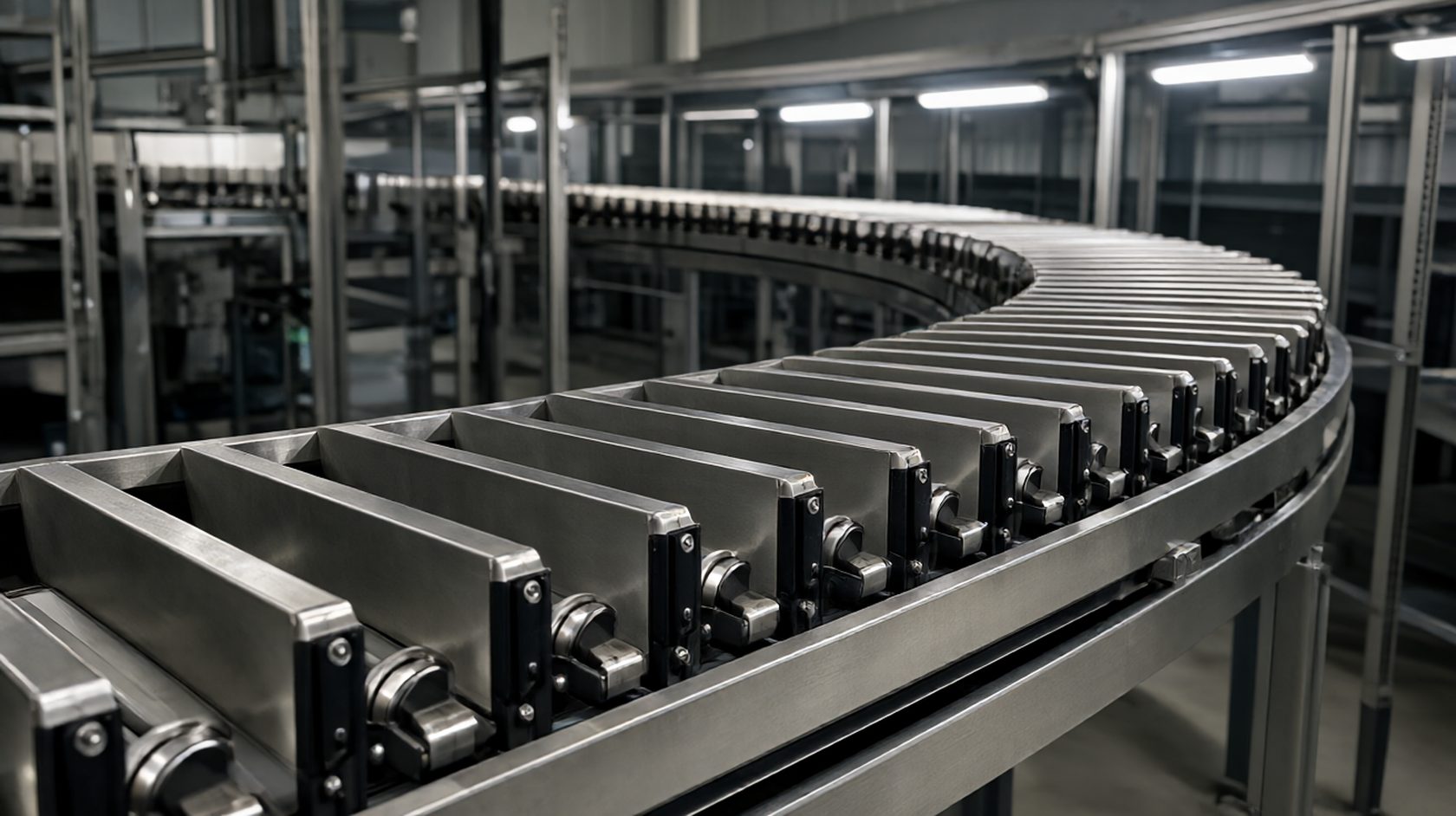
Pitch sets the tray count and the tray count sets everything
A line of a given length holds a number of cells equal to the length divided by the pitch. That number is the line's capacity in three separate senses: parcels in flight, destinations served per revolution, and recirculation buffer.
A shorter pitch packs more cells into the same frame, and more cells means more parcels in flight at the same speed. That is the throughput argument, and it is the argument that gets made first because it is the easiest to quantify.
The destination argument is less obvious and more important. Each discharge point on the line corresponds to a chute, and the number of chutes a line can serve is constrained by how many cells pass each chute per revolution. More cells means more chances per revolution, which means a destination can be served at lower volume without waiting multiple revolutions.
The buffer argument is the one that appears during commissioning. A parcel that misses its discharge has to wait a full revolution, and the number of parcels waiting is bounded by the number of cells. A line with few cells saturates its buffer at a lower miss rate, and saturation is when recirculation becomes a line stop.
Destination count is the number to fix first
The first question is how many distinct destinations the operation needs to serve, not how long the line should be. Destinations come from the route structure, the carrier split, the store list or the zip band, and they are a business fact rather than an engineering choice.
With the destination count fixed, the minimum cells per revolution follows from the volume per destination and the acceptable wait. A destination that receives one parcel per hour needs only one chance per hour, while a destination that receives fifty needs many more.
The cells per revolution then sets the pitch for a given line length, or the line length for a given pitch. Those two are the same equation, and the practical constraint is usually the building rather than the arithmetic.
Working in this order prevents the most common mistake, which is buying a long line with a long pitch and discovering that the destination count cannot be served at the volumes involved without multiple recirculations.
The discharge window is pitch divided by speed
A parcel has to leave the tray while the tray is adjacent to the chute. The time available is the distance over which discharge is possible divided by the line speed, and that distance is bounded by the pitch.
This is the constraint that a short pitch makes harder. A shorter pitch gives a shorter window at the same speed, which means the cross belt has to accelerate and complete the discharge faster. Faster discharge means higher forces on the parcel and a narrower set of parcels the mechanism can handle reliably.
The countermeasure is to slow the line. Slowing the line lengthens the window and reduces throughput in exactly the proportion that the shorter pitch increased it. The two effects partially cancel, which is why a short pitch does not deliver the full theoretical gain.
The real gain from a short pitch is therefore the cell count rather than the speed. A line that runs at a moderate speed with many cells achieves a high throughput because parcels are dense, not because they are fast. That is a safer operating point than a fast line with few cells.
Higher speed narrows the parcel set
Every increase in line speed reduces the set of parcels that can be discharged reliably. Light parcels are affected first because the cross belt has less mass to work with, and soft parcels are affected next because they deform under acceleration.
This means the achievable throughput on a fast line is computed on the subset of the catalogue that can survive the speed, not on the whole catalogue. A line quoted at a high throughput against a full catalogue is quoting a throughput that the full catalogue cannot deliver.
The subset effect is usually invisible in the specification and highly visible in operation. The line runs at the quoted speed, a share of parcels discharge late, and the operators learn to slow it down, at which point the throughput matches a slower and cheaper machine.
The correct specification states the speed and the parcel subset it applies to. A supplier who quotes speed without the subset is quoting a number that will be renegotiated during commissioning, and the renegotiation will be conducted with less leverage than the purchase.
Cell pitch and curve radius are the same drawing
A cell travelling through a curve sweeps an envelope wider than its straight line width. The tighter the curve, the wider the sweep, and the sweep is what the frame has to accommodate without the cells interfering.
A shorter pitch in a curve means more cells in the same arc, each sweeping the same envelope, which increases the chance of interference and the wear on the guide. The curve is therefore the place where a short pitch stops being an advantage.
The usual design answer is to keep the tight curves out of the sorter and use straight runs with 180 degree ends at generous radius. That is a layout decision, and it constrains where the sorter can be placed relative to the building's columns and walls.
Where a tight curve is unavoidable, the pitch has to be increased locally or the speed reduced through the curve. Both are capacity costs that appear in the layout rather than in the equipment, and both are cheaper to resolve on the drawing than after installation.
Recirculation is the buffer that nobody sized
Recirculation is the mechanism that lets a cross belt sorter serve destinations that are not currently reachable. A parcel waits on a tray until its chute comes around, and the waiting is the buffer.
The buffer size is the cell count, and the buffer is consumed by every miss. On a line with a high miss rate the buffer fills, and a full buffer means the sorter cannot accept new parcels from induction, which presents as an induction problem.
Miss rate is therefore a capacity parameter rather than a quality parameter. A line running at a five percent miss rate consumes five percent of its cells as buffer, which is a five percent reduction in effective throughput that does not appear in the throughput calculation.
The specification should state the assumed miss rate and the resulting buffer requirement. A line sized without a miss assumption is sized for perfect operation, and perfect operation is not a state that exists in a parcel building.
Cell replacement is a routine, not an exception
A cross belt cell is a small belt conveyor with a drive, and small belt conveyors wear. Cell replacement is a routine maintenance activity on a line with hundreds of cells, and the procedure for it determines the downtime per event.
A shorter pitch packs cells more tightly, which makes each cell harder to reach and the replacement procedure longer. The downtime per event rises while the number of events stays roughly constant with the cell count, so the total maintenance downtime rises faster than linearly.
The design answer is a removable cell module that can be isolated and lifted out without disturbing its neighbours. That is a specification item rather than a standard feature, and it should be requested explicitly because it changes the frame design.
Where the module is not available, the procedure has to specify a line stop and a planned window. An unplanned window on a busy line becomes a deferred replacement, and deferred replacement becomes a cell that fails in service.
Fewer cells is sometimes the right answer
A line with fewer cells is simpler, cheaper, easier to maintain and less sensitive to the miss rate. It serves fewer destinations per revolution, which is acceptable when the destination count is low or the volume per destination is high.
This profile is common in a single retailer's distribution centre, where the destination count is the store list and each store receives a meaningful daily volume. In that profile the long pitch line is the right machine.
The profile where the short pitch wins is a parcel carrier hub, where the destination count is large and each destination's volume is modest. There the cell count is the thing that makes the line work at all.
The mistake is to apply one profile's specification to the other. A carrier hub built with a retailer's pitch will recirculate most of its parcels. A retailer's DC built with a hub's pitch will pay for cells it cannot fill.
Dual use of the cell complicates everything
A cell large enough for two parcels can carry two, and the second parcel changes the discharge timing, the tray surface requirement and the miss rate. Dual use is a mode, and a mode has to be specified rather than discovered.
The mode also changes the destination logic, because two parcels with different destinations on one cell cannot both discharge on one pass. The control system has to decide which one to discharge, and that decision is a policy rather than a rule.
Where dual use is intended, the pitch should be chosen for the pair rather than for the single parcel, which pushes toward a longer cell. That interacts with the destination count requirement in the opposite direction, and the two requirements have to be traded explicitly.
Where dual use is not intended, the control system should refuse it rather than allow it opportunistically. Opportunistic dual placement is how a line develops a discharge error rate that nobody can attribute to a cause.
The specification page that prevents all of this
One page carries the destination count, the volume per destination, the acceptable wait per destination, the parcel subset that must run at full speed, the assumed miss rate and the resulting buffer requirement.
From those six numbers, the cell count follows, then the pitch for the available length, then the speed for the discharge window, then the cell size for the parcel subset. Each number is derived from a stated requirement rather than from a catalogue.
The page should also state what happens if a requirement changes. A destination count that grows by twenty percent needs more cells or a longer line, and knowing that in advance is what makes the growth a planned extension rather than a rebuild.
The page is short and it is the most useful document in the project, because it converts a machine purchase into a statement of what the operation needs the machine to do. Everything after it is a check against that statement.
The pitch this arithmetic arrives at is the one on the cross belt sorter on the shorter cell pitch, and the cell count it produces is what the destination list has to be served with.
- Fix the destination count before fixing the line length or the pitch.
- Size cells per revolution from volume per destination and acceptable wait.
- Compute the discharge window as pitch divided by speed.
- State the parcel subset that can run at the quoted speed.
- Keep tight curves out of the sorter path and use generous radii at the ends.
- State an assumed miss rate and the resulting recirculation buffer requirement.
- Request removable cell modules that isolate without disturbing neighbours.
- Match the pitch profile to the business: retailer DC or carrier hub.
- Specify whether dual placement is intended and configure the controls accordingly.
- Refuse opportunistic dual placement where it was not designed.
- Record the six specification numbers on one page.
- State what changes when the destination count grows.